



If you’ve been thinking about getting into trading, there’s a good chance you’ve found yourself torn between the three big markets everyone talks about:
- Forex (currencies)
- Stocks (company shares)
- Crypto (digital assets)
Each market has its own personality – its own mood swings, opportunities, risks, and learning curve. And choosing where to begin can feel a little overwhelming, especially if you’re constantly hearing conflicting opinions from YouTube gurus, trading forums, or Twitter “experts.”
So, instead of throwing random jargon at you, let’s break this down in a simple, honest, trader-to-trader way… the way someone would explain it over a late-night Discord chat.
Let’s Start With the Basics: What Each Market Really Feels Like
Before we compare them, here’s the “human version” of what each market actually feels like to trade.
Forex (Foreign Exchange)
Best for: steady, structured, round-the-clock trading.
Forex is like the 24/7 diner of financial markets. It’s always open during weekdays, always moving, and mostly predictable in its behavior.
You’re trading currency pairs like:
- EUR/USD
- GBP/USD
- USD/JPY
- AUD/USD
Forex tends to move smoothly most days, reacting to global economics, interest rates, and news. It’s the market many beginners like because:
- spreads are low
- liquidity is huge
- price action is clean
- charts make sense
- big sudden spikes aren’t as common as crypto
If you enjoy structure, rules, and a calmer environment, forex fits you well.
Stocks (Equities)
Best for: people who like fundamentals and slow, steady growth.
Trading stocks means you’re buying small pieces of real companies like:
- Apple
- Tesla
- Microsoft
- NVIDIA
- Amazon
Stock trading is less “fast and furious” than forex or crypto. It’s influenced by:
- earnings
- news
- company performance
- broader economic cycles
Stocks are perfect if you like digging into fundamentals or prefer a long-term approach. Intraday stock trading is a bit tougher because:
- there are trading hours
- market opens can be chaotic
- volatility spikes are common
- small accounts struggle with pattern-day-trading rules
But overall, stocks are stable, slower-moving, and easier to understand logically.
Crypto (Digital Assets)
Best for: thrill-seekers, trend traders, and night owls.
Crypto is like the wild child of the trading world.
It’s open 24/7.
It moves aggressively.
It ignores traditional rules.
And it can double or crash in the same week.
When you trade crypto, you’re trading coins like:
- Bitcoin (BTC)
- Ethereum (ETH)
- Solana (SOL)
- XRP
- and hundreds of altcoins
Crypto offers massive opportunity but equally massive risk. The swings are huge. The trends are powerful. The reversals come out of nowhere.
If you enjoy fast markets, volatility, and quick setups, you’ll feel right at home.
Now Let’s Compare Them Head-to-Head
To make things easier, here’s what actually matters when choosing where to start.
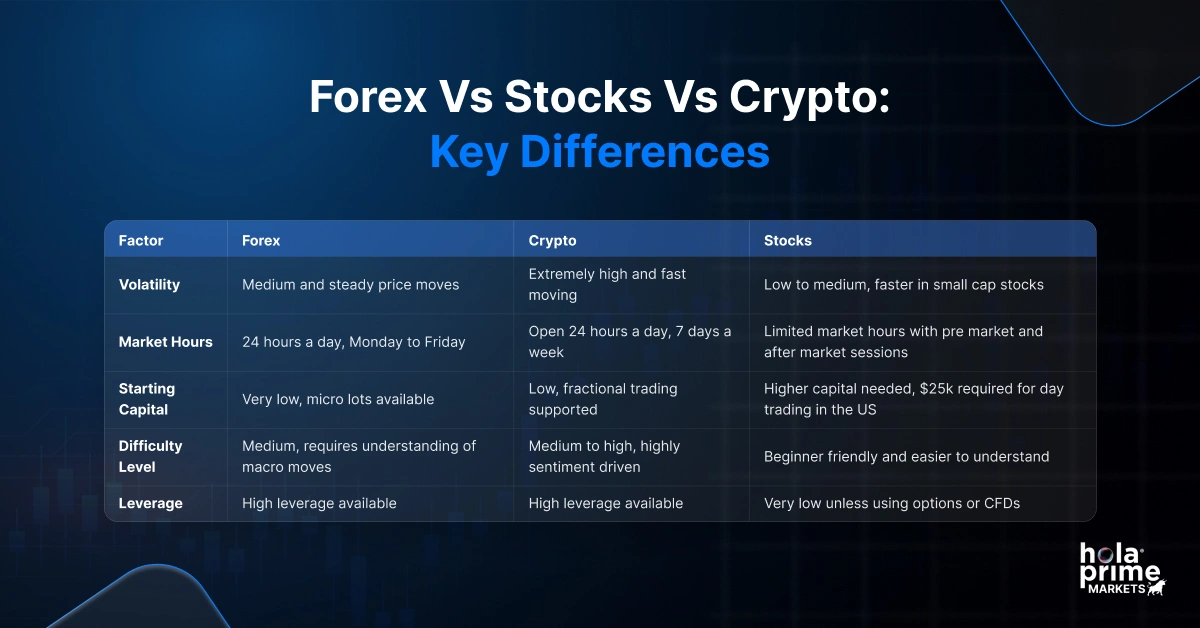
1. Volatility (How fast prices move)
- Crypto: Extremely high
- Forex: Medium
- Stocks: Low-to-medium
Crypto offers the fastest moves, which can be exciting but dangerous. Forex moves steadily. Stocks move slower unless you’re trading small caps.
2. Market Hours
- Forex: 24 hours a day (Mon–Fri)
- Crypto: 24/7
- Stocks: Limited hours (plus pre-market & aftermarket)
If you don’t have a fixed schedule, crypto and forex give you more flexibility.
3. Starting Capital Requirements
- Forex: Very low (micro lots available)
- Crypto: Low (fractional trading)
- Stocks: Higher and day trading requires $25k in the U.S.
This is why many beginners avoid stocks at first.
4. Difficulty Level
- Forex: Medium
- Crypto: Medium to high
- Stocks: Beginner-friendly
Stocks feel more intuitive – you’re trading real businesses, not currency value or digital tokens.
5. Leverage Availability
- Forex: High
- Crypto: High
- Stocks: Very low (unless using options or CFDs)
Leverage can accelerate profit – but wipe out accounts just as quickly.
Forex vs Stocks vs Crypto: Which Should You Choose?
Let’s break it down based on your personality and goals.
Choose Forex If:
- You want structure and routine
- You prefer technical trading
- You want a calmer environment
- You don’t want to face wild 50% drawdowns
- You want tight spreads and high liquidity
Forex is the “professional trader’s playground” – orderly, predictable, consistent.
Choose Stocks If:
- You care about fundamentals
- You’re patient
- You like researching companies
- You’re aiming for long-term wealth
- You want a slow-and-steady environment
Stock traders are often the most relaxed long-term investors.
Choose Crypto If:
- You thrive on volatility
- You like fast setups
- You enjoy 24/7 markets
- You aren’t afraid of big swings
- You want explosive opportunities
Crypto is exciting, unpredictable, and full of opportunities for both traders and investors.
So… Which Market Is “Best”?
Honestly?
There’s no universal best market.
There’s only the best market for you.
Your temperament, schedule, risk tolerance, and trading goals matter more than anything else.
A trader who loves volatility might fall asleep trading stocks.
A long-term investor might panic trading crypto.
Someone who wants calm execution might find forex easier than anything else.
Pick the market that fits your personality – not the one social media hypes the most.
Final Thoughts: Start Where You Feel Most Natural
If you’re still unsure, here’s the simplest rule:
Start with the market you understand the most.
If currencies make sense to you → trade forex.
If you love companies → trade stocks.
If you’re passionate about blockchain → trade crypto.
The market you connect with emotionally is the market you’ll trade most consistently – and consistency is what actually creates success.