



When you first step into forex trading, one of the first things you realise is that currency pairs rarely move without a reason. Even on quiet days, something in the background is influencing how one currency behaves against another. At Hola Prime Markets, we often see newer traders focus only on price charts, without noticing the underlying drivers that shape those moves. Once you learn what actually pushes a pair up or down, you start making sense of those sudden swings or slow trends that sometimes leave you confused. Understanding what moves currencies gives you a clearer view of the market and helps you make decisions that aren’t based only on short-term noise.
1. Economic Data: The Day-to-Day Fuel Behind Price Moves
Economic releases often create some of the loudest reactions in the forex market because traders worldwide watch the same numbers. Events like GDP, inflation, employment reports, retail sales and manufacturing data all paint a picture of how well an economy is performing. When the numbers come in better than expected, a currency usually strengthens because investors see that country as more stable or attractive. When they come in weak, the opposite tends to happen. But what many traders forget is that the market often reacts to the “surprise factor” rather than the number itself.
If the traders and investors expected strong data and get only a slight improvement, the currency can fall simply because expectations weren’t met. This is why economic calendars matter so much in forex trading, especially if you want to understand intraday volatility or plan trades around scheduled releases instead of being blindsided by them.
2. Central Banks: The Long-Term Compass of Currency Direction
The majority of currencies and the fluctuations these currencies experience is dictated by the calendar for when central banks announce monetary policy for its corresponding currency. Whether it’s the Federal Reserve, the ECB, the Bank of Japan, or whoever it might be, the policy they dictate manages expectations – which is again how traders determine the value of a currency. The highest return for holding currency is clear and most commonly discussed in headlines is the interest rate. Higher interest rates attract investment whereas lower interest rates push traders away.
In addition to published interest rates, central banks guide expectations by governors in speeches, meeting minutes and even through changes in language. A couple only words hinting they might cut interest rate expectations – a change that could take some time to be noted in a number and not change post adoption of base monetary policy – can produce a material move in a currency. The trading process becomes more efficient when you know how to not only read the decision but the attitude as well.
3. Geopolitics: The Events No Chart Can Predict
Geopolitical events can shake up the forex market without warning. Things like elections, conflicts, trade negotiations, sanctions or sudden policy shifts can push currencies into strong moves, especially when uncertainty rises. Traders tend to run toward safe-haven currencies during turbulent moments, which is why pairs like USDJPY or USDCHF behave differently during global stress. You’ll often see sharper movements during these times because markets react emotionally just as much as logically.
Even seasoned traders sometimes forget that sentiment plays a big role in currency movement. Once you start factoring geopolitical risks into your analysis, you’ll notice that currency behaviour becomes easier to interpret because you’ll have a sense of why certain pairs are acting unusually, even when no major economic data has been released.
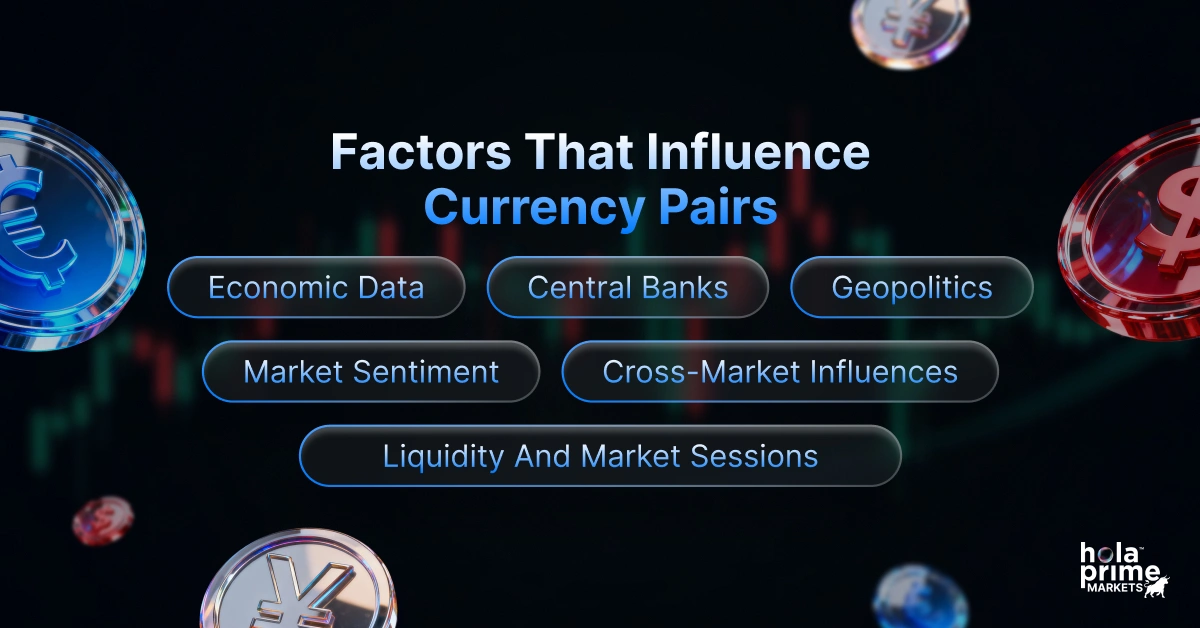
4. Market Sentiment: The Hidden Force Behind Many Price Swings
Sentiment doesn’t show up on calendars, but it influences the forex market constantly. Traders as a group tend to move in waves based on confidence, fear or expectations about upcoming events. If markets feel positive, riskier currencies such as AUD or NZD often strengthen, while safe-haven currencies weaken. When fear increases, the pattern reverses. What makes sentiment tricky is that it’s built from many small pieces of information, from news headlines to social media chatter to large institutions adjusting positions quietly in the background.
Many traders learn to read it through price action, volume behaviour or the way correlations shift between asset classes. When you develop a sense for sentiment, you understand why certain moves happen even if you don’t see a direct news trigger. It becomes one of the most valuable skills you can build over time.
5. Cross-Market Influences: How Commodities, Equities, and Bonds Play a Role
There are currency pairs that tend to follow the movement of other markets closely, and, as a result, traders who identify these connections may have an added advantage. For example, currencies such as the AUD and CAD may follow commodity prices closely, given their economies are largely based on natural resources. Generally, as oil goes up, the CAD appreciates, and as oil declines, it tends to weigh on the CAD. The bond market also relates to yield expectations, which is important when it comes to any currency linked to interest rate speculation.
The equity market also creates an avenue for risk sentiment, which subsequently filters into currency strength or weakness. When you start to identify these consecutive relationships, trading often becomes a puzzle; not knowing exactly the picture you’re entering into, but knowing each piece illustrates a little more of the complexity involved.
6. Liquidity and Market Sessions: Why Timing Matters
Different sessions create different levels of activity. The Asian session usually sees calmer movements compared to London or New York, while overlaps often bring out the largest swings of the day. Liquidity affects spreads, momentum and breakout behaviour. Many newer traders overlook how much timing influences their results, but once you experience a few sessions, you realise that the same strategy behaves differently depending on the time of day.
Conclusion
Currencies move for many reasons, and no single factor tells the whole story. But when you combine economic data, central bank policy, sentiment, geopolitics, and cross-market relationships, you begin to understand why prices behave the way they do. With that understanding, trading becomes far more structured and less stressful because you’re no longer reacting blindly to price movements. At Hola Prime Markets, we encourage traders to take a broad view of the market so they can make informed decisions that align with both their strategy and the bigger picture driving currency behaviour.