


When most people think about commodities, they jump straight to gold, oil, or maybe natural gas. But some of the most interesting opportunities for traders – especially those who enjoy movement, seasonality, and global demand – sit quietly in the softs and agricultural markets.
And two of the most active, widely traded, and opportunity-rich contracts are coffee futures and soybean futures.
If you’ve ever wondered why fund managers, prop traders, and even intraday retail traders pay close attention to coffee and soybeans, this guide will walk you through everything – the volatility, the price drivers, the seasonality, and how to actually trade them like someone who knows what they’re doing.
Let’s dive in.
Why Coffee and Soybean Futures Deserve a Spot on Your Watchlist
Coffee and soybeans might not be as flashy as Bitcoin or the Nasdaq 100, but they behave beautifully for active traders:
- They trend well during major supply shocks.
- They respond cleanly to fundamentals like weather, export data, and seasonal cycles.
- They offer strong liquidity thanks to institutional traders and the global physical market.
- They give you diversification from equity-heavy portfolios.
And in a world where inflation, climate disruptions, and geopolitical tensions constantly shake up supply chains, these commodities stay relevant and often move first before macro headlines hit the front page.
Section 1: Trading Coffee Futures – The Volatile Favorite
Coffee might be the most emotional commodity on the board. A frost in Brazil? Boom – prices fly.
A bumper crop? Market tanks.
A shipping bottleneck? Strap in.
What are Coffee Futures?
Coffee futures (usually the ICE Arabica Coffee “KC” contract) allow traders to speculate on the future price of coffee beans. One standard contract controls 37,500 pounds of coffee, which means even small price movements can generate meaningful P&L.
Why Coffee Moves the Way It Does
Coffee is largely dominated by weather and crop cycles. The main driver?
Brazil.
As the world’s largest coffee producer, whatever happens in Brazil’s farms becomes a global event.
Major factors that move coffee futures price include:
✔ Crop damage from frost or drought
✔ Coffee rust disease
✔ Transport/logistics disruptions
✔ Changes in global demand (yes, caffeine is recession-proof)
✔ USD fluctuations
✔ Inventory levels in ICE-certified warehouses
Coffee is one of the most sensitive commodities to weather news – meaning traders who like fast markets with clean catalysts absolutely love it.
Best Styles for Trading Coffee Futures
- Swing trading: trending moves often last weeks to months
- News-based trading: weather alerts in Brazil, crop reports
- Seasonal trading: historically, coffee shows strong patterns tied to harvest cycles
- Breakout trading: KC reacts sharply to technical levels
Coffee rarely just “drifts.” It either trends, spikes, or reverses aggressively – which, for prepared traders, is exactly what you want.
Section 2: Soybean Futures – The Backbone of Global Agriculture
While coffee gives you volatility and emotional markets, soybeans give you structure – backed by massive global demand and predictable seasonal catalysts.
What Are Soybean Futures?
Soybean futures (Z S contracts on the CME) represent 5,000 bushels of soybeans. They’re used heavily by:
- Farmers
- Food manufacturers
- Exporters
- Hedge funds
- Prop desks
If you’re looking for liquidity, you’ll find plenty here.
Why Soybean Futures Are So Widely Traded
Soybeans sit at the center of global agriculture because they’re used for:
- Animal feed
- Cooking oil
- Biofuel
- Export revenue for the US, Brazil, and Argentina
This makes soybean futures trading one of the most-watched markets in the world.
Major Price Drivers
The soybeans futures contract is influenced by:
✔ USDA WASDE reports (huge market movers)
✔ Weather in the US Midwest
✔ Brazil & Argentina harvest yields
✔ Biofuel policy changes
✔ China’s import demand
✔ Crop rotation decisions
✔ Fertilizer prices
Soybeans react strongly to fundamentals, which makes them perfect if you enjoy trading based on economic news, supply-and-demand shifts, or macro trends.
Section 3: Coffee vs Soybeans – Which Market Should You Focus On?
Here’s a quick, honest breakdown:
If you like…
Volatility and sudden spikes
You’ll enjoy coffee futures.
Structured markets and fundamental depth
Soybeans will feel more predictable.
Trading around reports and news
Both are excellent, but soybeans respond especially well to USDA data.
Medium-term trending markets
Both coffee and soybeans trend beautifully on strong supply/demand shifts.
Clear seasonal cycles
Soybeans are easier to analyze seasonally, but coffee also has strong harvest-linked patterns.
In short, you can trade both – but your personality will naturally match one more than the other.
Section 4: How to Trade Coffee and Soybean Futures Like a Pro
Let’s talk strategy – the part traders care about.
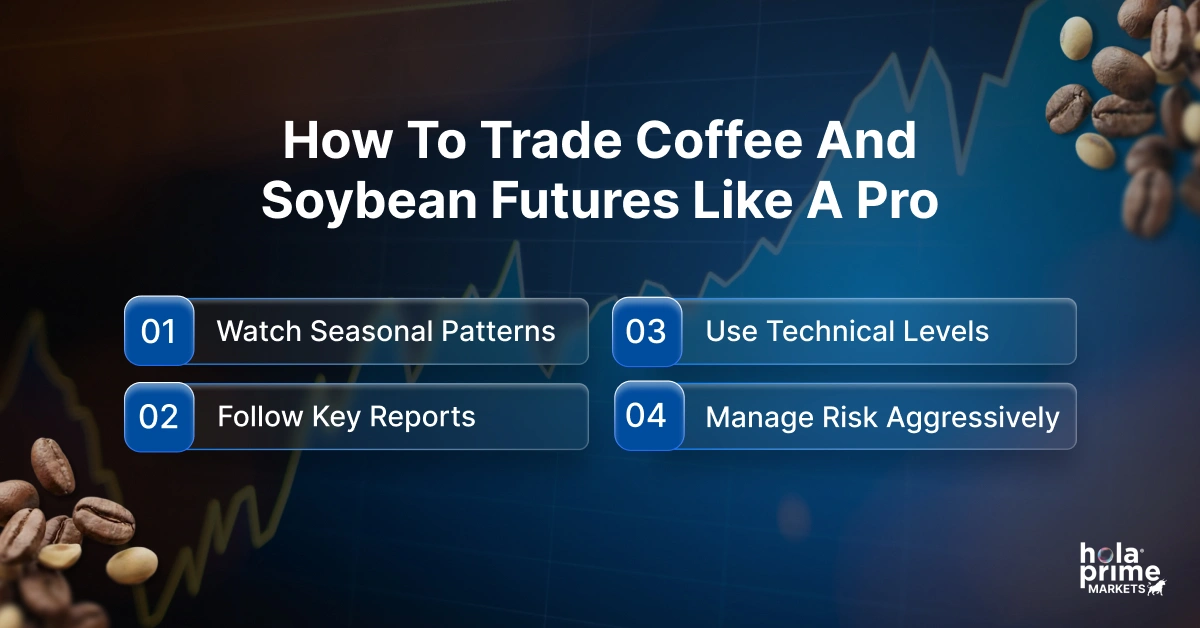
1. Watch Seasonal Patterns
Agricultural commodities behave differently across the year.
For example:
- Soybeans often move during planting (April–June) and harvest (September–November).
- Coffee often moves during the Brazilian winter frost season (June–August).
You don’t need to predict these cycles – just respect them.
2. Follow Key Reports
For soybeans:
- USDA WASDE
- Quarterly Grain Stocks
- Prospective Plantings
For coffee:
- Brazil crop forecasts
- ICE warehouse stocks
- CONAB reports
These reports regularly create major opportunities.
3. Use Technical Levels
Both markets respond cleanly to:
- Trendlines
- Fib retracements
- Key moving averages
- Support/resistance zones
You’ll often see institutional behavior around round numbers (100, 150, 200 in KC coffee).
4. Manage Risk Aggressively
Soft commodities can move fast.
A weather headline can rip through the market before most retail traders even refresh their chart.
Use:
✔ Stop losses
✔ Small positions during news weeks
✔ Volatility-adjusted sizing
This is not a market where you “hope” something comes back.
Section 5: Why Many Prop Traders Love These Contracts
Coffee and soybean futures offer:
- Lower correlation with equity indices
- Big moves from small catalysts
- Strong liquidity
- Short-term and long-term setups
- Clear macro themes
- Seasonal patterns that actually work
If you trade only indices or forex, adding one agricultural market can instantly diversify your entire approach.
Final Thoughts: Should You Trade Coffee and Soybean Futures?
Absolutely – as long as you’re prepared.
Coffee gives you volatility, emotional markets, and fast movement.
Soybeans give you structure, depth, and beautiful report-driven setups.
Together, they offer a balanced, opportunity-rich corner of the futures world that many traders simply overlook.
And in a market landscape where everyone focuses on the same few assets, trading something different – something real, with global supply and demand behind it – can give you the edge you’ve been looking for.
If you’ve never explored agriculture futures, consider this your invitation.
The opportunities are there. You just need the curiosity to step in.