At some point in every trader’s journey, this question shows up: “Should I focus on technical analysis or fundamental analysis?” And usually right after that comes another thought: “Which one actually works better?” The honest answer? Both work. Both fail. And neither is magic on its own. Let’s break this down in a way that actually helps you trade, not just win a debate.
First, What Is Technical Analysis?
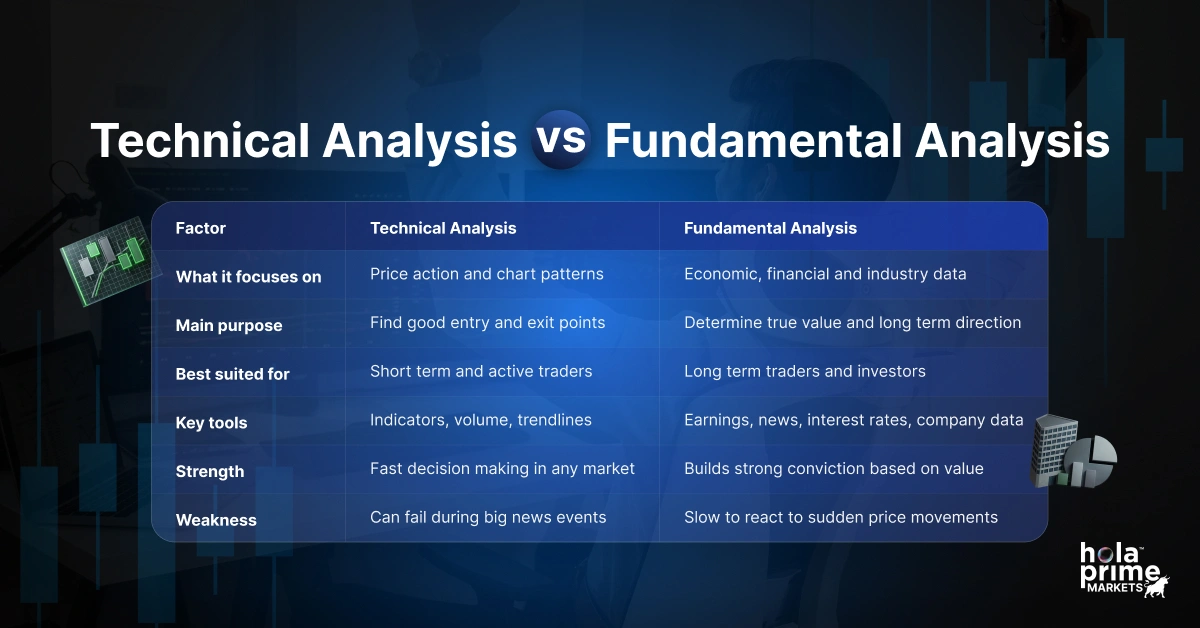
Technical analysis is all about price. It focuses on:
- charts
- patterns
- indicators
- support and resistance
- trends
- momentum
The idea is simple: Everything the market knows is already reflected in the price. Instead of asking why price is moving, technical analysis asks: “What is price doing right now, and what is it likely to do next?”
How Technical Analysis Is Used in Real Trading
Traders use technical analysis to:
- time entries and exits
- identify trends
- find high-probability setups
- manage risk
Common tools include:
- candlestick patterns
- moving averages
- RSI and MACD
- trendlines
- chart patterns
It’s visual, fast, and very practical.
Strengths of Technical Analysis
Technical analysis works well because: ✔ It applies to any market i.e. commodity, forex, futures ✔ It works on any timeframe ✔ It helps with precise entries ✔ It reacts quickly to price changes This is why:
- day traders
- scalpers
- swing traders
tend to lean heavily on technical analysis.
Limitations of Technical Analysis
But it’s not perfect. Technical analysis:
- doesn’t explain why markets move
- can give false signals in choppy markets
- requires discipline and experience
Indicators don’t predict - they react. That’s an important distinction.
Now, What Is Fundamental Analysis?
Fundamental analysis looks at the bigger picture. Instead of charts, it focuses on:
- economic data
- interest rates
- inflation
- earnings
- company performance
- geopolitical events
The core question is: What is this asset actually worth?
How Fundamental Analysis Is Used in Trading
Fundamental analysis helps traders:
- understand long-term direction
- spot undervalued or overvalued assets
- anticipate major market shifts
For example:
- Rate cuts boosting stocks
- Inflation supporting gold
- Earnings driving stock prices
It’s about context, not timing.
Strengths of Fundamental Analysis
Fundamental analysis shines because: ✔ It explains why markets move ✔ It helps identify long-term trends ✔ It builds conviction in trades ✔ It filters noise from meaningful moves This makes it popular with:
- investors
- position traders
- macro traders
Limitations of Fundamental Analysis
Here’s the catch. Fundamental analysis:
- doesn’t give precise entry points
- can be slow to play out
- can be ignored by the market short-term
A market can stay irrational longer than most traders expect.
So… Technical vs Fundamental Analysis: Which Is Better?
This is where most people get stuck. The truth is: It’s not technical or fundamental. It’s technical and fundamental. They answer different questions.
| Question | Best Tool |
| Where is price going long-term? | Fundamental |
| When should I enter? | Technical |
| How do I manage risk? | Technical |
| Why is the market moving? | Fundamental |
 What Most Successful Traders Actually Do Most experienced traders combine both. For example:
- Use fundamental analysis to pick direction
- Use technical analysis to time trades
Think of fundamentals as the map and technicals as the GPS. One gives direction. The other gives precision.
Which Is Better for Beginners?
If you’re just starting out:
- Technical analysis is usually easier to learn first
- It gives immediate feedback
- It helps you understand market structure
But ignoring fundamentals completely isn’t wise. Even basic awareness - like knowing when major news or earnings are coming - can save you from unnecessary losses.
A Common Beginner Mistake
Many new traders try to master everything at once. They:
- overload charts with indicators
- read every economic headline
- jump between strategies
This leads to confusion. Start simple:
- one market
- one timeframe
- a few key tools
Clarity beats complexity every time.
Technical Analysis vs Fundamental Analysis: Which Is Better for You?
Ask yourself:
- Do I trade short-term or long-term?
- Do I like charts or data?
- Do I prefer fast decisions or deep analysis?
Your style matters more than the debate.
Final Thoughts: Stop Choosing Sides, Start Trading Smarter
The market doesn’t care which analysis you prefer. It only responds to:
- discipline
- consistency
- risk management
Technical and fundamental analysis are just tools. The best traders don’t argue about which one is better - they use the right tool at the right time. And once you understand that, trading becomes a lot less confusing… and a lot more effective.